Porn fantasy in good quality is rare: most often it’s cheap costumes and rough editing. Elves in cheap fake ears, “androids” in silver face paint, giantesses hastily pasted onto a photo of a city. Everything truly beautiful in this genre mostly exists in drawings and anime, and if you want to see a lamia or an android girl in a living, realistic video, you’ll have to search for a very long time.
With a neural network you can create such a heroine yourself. First you generate her photo from a description and bring it to perfection: tail, wings, glowing eyes, setting. Then, based on that photo, you create a porn video where the heroine comes to life. Below we break down the main formats of fantasy-style porn: where each one came from, which details are key in it, and which prompts to use for the photo and for the video.
Create a photo of your fantasy heroine and turn it into an AI video.
Giantesses: porn fantasy about size
The center of this format is the difference in scale. A heroine of enormous height towers over the city, holds a car in her palm, or carefully steps over houses. In the community such heroines are called GTS for short, from the English giantess, and the interest itself is macrophilia.

Where it came from. Characters of unusual height have appeared in culture for centuries. The most famous literary ancestor is Jonathan Swift’s Gulliver’s Travels of 1726, where the hero first ends up among tiny Lilliputians and then in the land of giants Brobdingnag. The second classic image is the 1958 American film Attack of the 50 Foot Woman, whose heroine grows to enormous size. The first site entirely devoted to this theme appeared in 1997.
Height scale. Fans even have their own classification. Heroines from 5 to 15 meters tall are called mini-giantesses, above 30 meters — mega-giantesses, and the truly colossal ones — “Brobdingnagian,” after the country from Swift’s book.
What’s important in the scene. Scale is only readable through comparison, so the frame almost always contains familiar objects: cars, houses, trees, lampposts. Attention is often focused on shoes and feet, because they emphasize size the most. That’s why this format often intersects with foot fetish.
The reverse side. There is also a mirrored version where the world around is huge and the character herself has shrunk to the size of a palm. Here the same thing matters: contrast with familiar objects.
Robots and androids in porn fantasy
In this format the heroine is an artificial being: an android, a gynoid (a robot in female form), or a cyborg. Among fans it is known under the abbreviation ASFR, which came from the name of the alt.sex.fetish.robots group on Usenet, one of the early discussion networks.
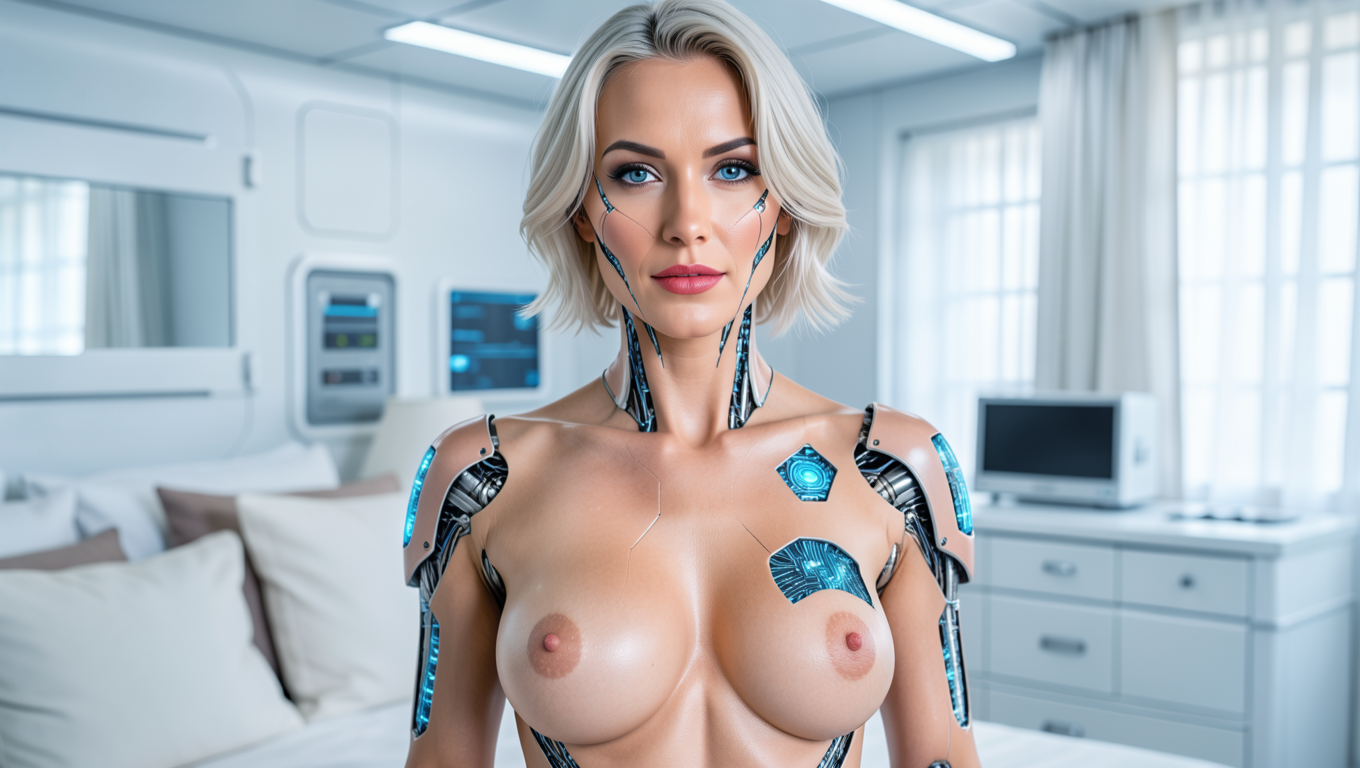
Where it came from. The image of a seductive woman-machine appeared almost a hundred years ago. In Fritz Lang’s silent film Metropolis of 1927 the robot takes on the appearance of the heroine Maria, and this scene is considered one of the first where a machine is shown as an object of attraction. Later many fans of the format recalled that they first became interested in it while watching actresses in robot roles in science-fiction series such as The Twilight Zone.
Two directions. Researchers distinguish two types of fantasies in ASFR. In the first the center is a finished android partner created specially for its owner. In the second — the transformation of a human into a robot.
What’s important in the scene. Fans are divided into those who like an android almost indistinguishable from a human and those who prefer a clearly mechanical look: metal skin, chrome, exposed parts. For many the moments that reveal the heroine’s artificial nature are especially important: a panel opening on the skin, glowing eyes, smooth mechanical movements, or a glitch when the android freezes for a second or repeats the same action.
Statues and dolls in porn fantasy
A format close to robots in which the heroine freezes: she turns into a marble statue, a porcelain doll, or a mannequin. American researcher Allison de Fren, who studied the ASFR community, noted that this abbreviation actually unites several interests at once, including attraction to mannequins, dolls, and sculptures.
Where it came from. This format has one of the oldest cultural ancestors — the myth of Pygmalion from Ovid’s Metamorphoses. A sculptor falls in love with a statue he created from ivory, and the goddess Venus brings it to life. Since then the story of a statue that becomes a living woman, and of a woman who freezes like a statue, has been repeated in art again and again.
What’s important in the scene. The key here is the boundary between living and non-living. Many are attracted by the transition itself: warm skin gradually turns into marble, movements slow down and stop. Or the reverse process, when a motionless doll begins to breathe and opens its eyes. Textures matter: the sheen of porcelain, the veins of marble, the articulated joints of a doll.
Transformation: a plot that fits any of these heroines
All the heroines above appear in the frame already finished: as an android, a lamia, or a giantess. But any of them can be shown differently — so that the viewer sees how an ordinary woman becomes her. Such a plot is called transformation, or TF for short in the English-speaking internet. Here the main pleasure is in the transition itself.
Imagine a scene: the heroine stands in front of a mirror in an evening dress. First small horns appear on her temples, then wings slowly open behind her back, her eyes light up red. Half a minute later the viewer already sees a demoness, but the most interesting part is watching how it happened.
Where it came from. Stories of transformations are among the oldest in the world. Ovid’s poem Metamorphoses, written about two thousand years ago, consists almost entirely of plots about how people turn into trees, stones, springs, and stars. Fairy tales, myths, and fantasy have constantly returned to this theme ever since.
What the heroine most often turns into:
a fantasy creature: an elf, a demoness, a lamia;
an android, when skin gradually becomes metal;
a statue or a doll;
herself, but with a different appearance: a new skin, hair, or eye color, glowing patterns on the body.
What’s important in the scene. Gradualness. It is important to show every stage: where the first detail appears, how the change spreads across the body, how the heroine reacts to it — with surprise, delight, or calm. In a picture you can only show “before” and “after,” so the transformation truly unfolds in video. The photo of the heroine before the transformation becomes the base, and the video shows the process itself.
Monster girls: heroines from myths and bestiaries
A monster girl is a heroine whose human face and body are combined with the features of a mythical creature. In Japanese culture this genre is called “monmusu,” from the words “monster” and “musume,” meaning “girl.”
Where it came from. The roots of the genre are in Greek myths, Eastern folklore, and the bestiaries of fantasy games. Its modern look came from the manga Monster Musume by Japanese artist Okayado, which began publication in 2012, and the anime based on it in 2015. After that monster girls became a separate genre with its own established types.
Main types:
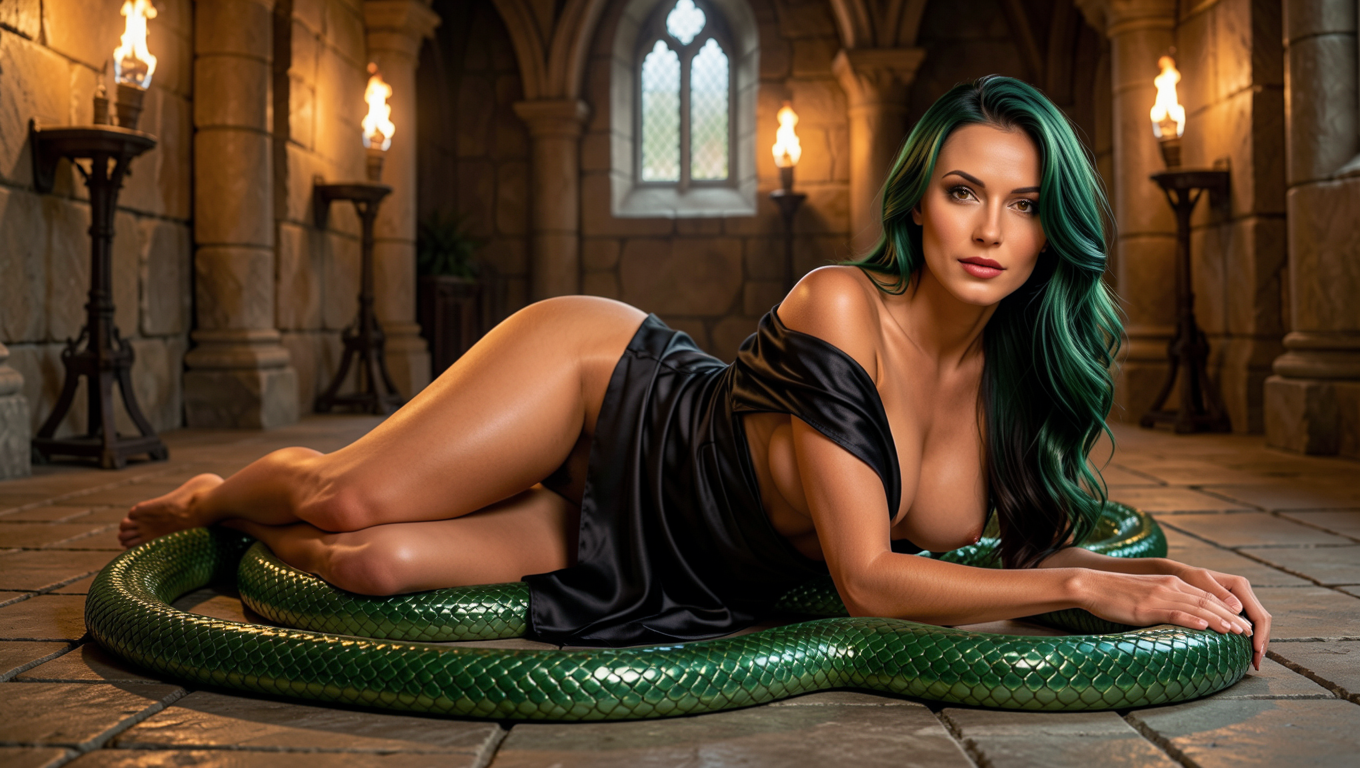
lamia — upper half of the body human, lower half a snake tail. The most recognizable image of the genre, whose roots go back to ancient Greek mythology;
harpy — wings instead of arms and bird legs;
centaur — human torso on a horse’s body;
mermaid — fish tail instead of legs;
arachne — lower part of the body spider-like;
slime — the heroine entirely made of semi-transparent jelly that can change shape;
dullahan — a heroine who carries her head separately from her body.
What’s important in the scene. The anime fetish for monster girls is built on the combination of an attractive human part and an unusual creature part. Attention is usually focused on the place where one turns into the other: the line where skin changes to scales, the feathers at the shoulders, the sheen of the slime’s semi-transparent body. It is important that the character remains recognizably adult: in anime style heroines are often drawn younger, and this needs to be watched.
Elves, succubi and vampires: fantasy classics
These heroines look close to human, and only a few characteristic details give them away. That’s why the format seems the softest of the fantastic ones, but each type has its own long history.
Elves. The modern image of elves largely took shape after J.R.R. Tolkien’s The Lord of the Rings, published in 1954–1955: tall, refined, eternally young beings living in harmony with nature. Anime and computer games added long pointed ears to it, which became the main mark of the type. Important details: ears, light or silvery skin, long hair, light fabrics, forest or magical setting.
Succubi. In medieval European folklore a succubus is a demon in female form who appears to men at night. In modern fantasy this is a seductive demoness with horns, bat-like wings, and a thin tail. Important details: horns, wings, tail, dark or red tones, warm muted light.
Vampires. The female vampire appeared in literature earlier than the most famous vampire. Sheridan Le Fanu’s novella Carmilla was published in 1872, 25 years before Bram Stoker’s Dracula. Since then the image of the vampire woman has been linked to gothic aesthetics. Important details: pale skin, fangs, red eyes, dark dresses, candles, old interiors.
Alien women: science-fiction aesthetics
The last major format is heroines from other planets. They can differ little from humans or, conversely, have an unusual skin color, glowing patterns on the body, antennae, or eyes of an unfamiliar shape.
Where it came from. The image of a beautiful alien woman was born in American science-fiction magazines of the 1930s–1950s, on whose covers space beauties constantly appeared. A cult example of this aesthetic was Roger Vadim’s 1968 film Barbarella, where the heroine travels to distant planets in futuristic costumes.
What’s important in the scene. An unusual but attractive appearance and a future setting: the interior of a spaceship, neon light, an alien landscape with two moons. Glowing elements on the skin, tight costumes, and a cold color palette work well.
All formats in one table
Format | Essence | Cultural ancestor | Key details for the prompt |
Giantesses | enormous height of the heroine | Gulliver’s Travels, 1726; Attack of the 50 Foot Woman, 1958 | cars and houses nearby for scale, low angle |
Robots and androids | artificial body | Metropolis, 1927 | chrome, seams on the skin, glowing eyes, mechanical movements |
Statues and dolls | frozen heroine | myth of Pygmalion | marble, porcelain, articulated joints, transition from living to non-living |
Transformations | process of change | Ovid’s Metamorphoses | stages of change, slow spread across the body |
Monster girls | human and mythical creature | Greek myths, manga Monster Musume, 2012 | tail, wings, scales, place of transition from skin to creature body |
Elves, succubi, vampires | fantasy races | The Lord of the Rings, medieval folklore, Carmilla, 1872 | ears, horns, wings, fangs, gothic or magical forest |
Alien women | heroines from other planets | science-fiction magazines of the 1930s–1950s, Barbarella, 1968 | unusual skin color, glowing patterns, spaceship interior |
How to create a fantasy heroine: first the photo, then the video
All these formats have one thing in common: they are impossible to film with actors without a huge budget for makeup and special effects. For a neural network the difference between an ordinary heroine and a heroine with a snake tail is minimal; you only need to describe her accurately.
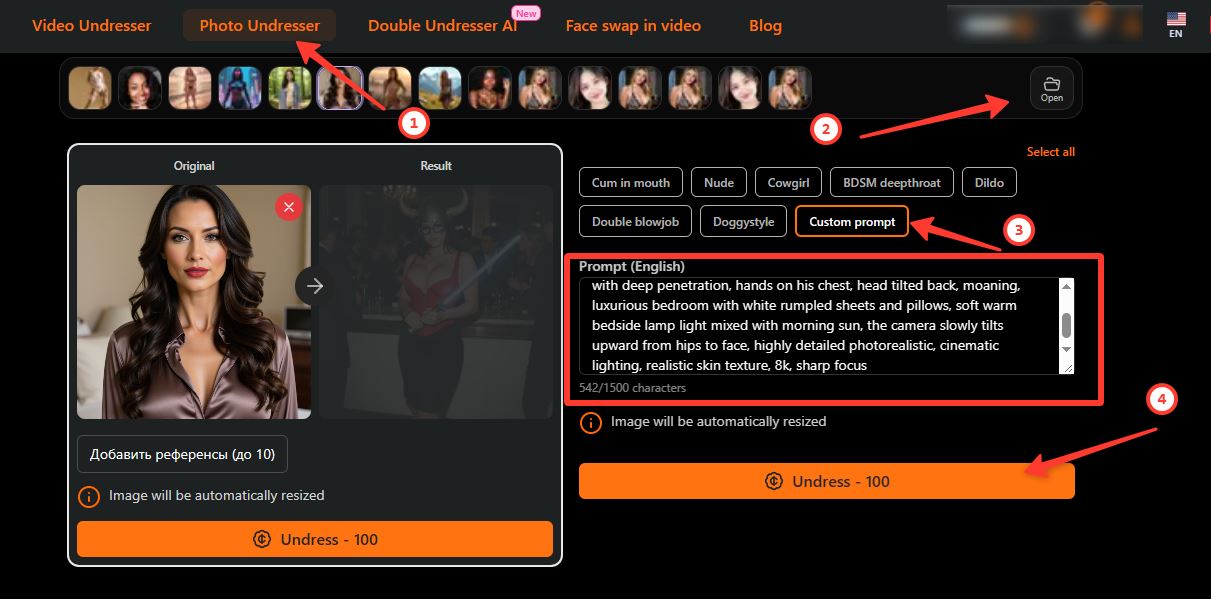
The most convenient way to work is in two steps. First create a photo of the heroine from a text description: appearance, unusual details, setting, light. Repeat until the heroine becomes exactly as you intended. Then upload this photo and create a video from it. In the second prompt you no longer need to describe the appearance; the neural network will take it from the photo. Describe only what should happen in the frame: the heroine’s movement, the camera’s work, changes in light.
For fantasy heroines this method is especially important. A tail, wings, or metal parts are easier to bring to perfection in a photo than to try to get them right immediately in video.
A few rules for the photo:
Show scale through objects. For a giantess it is not enough to write “giant woman.” Add cars, houses, or trees and choose a low angle.
Name the material. For androids, statues, and dolls write specifically: “polished chrome,” “white marble,” “glossy porcelain skin.”
Describe the place of transition. For monster girls indicate where the human body changes into the creature’s body: “below the waist her body becomes a snake tail.”
And one rule for the video: the movement must be slow and simple. Then the tail, wings, and fingers will keep their shape in every frame.
Prompts in the service are written in English. Here are examples for four formats.
Giantess Photo:
text
Low angle wide shot, giant adult woman around 30 years old, long dark hair, completely nude except for white sneakers, massive breasts and hips, standing in the middle of a small city, tiny cars and houses at her feet, bright sunny day, soft clouds, skin glistening with oil, confident seductive pose, one hand on hip, cinematic realistic style, highly detailed skin texture, photorealistic, 8kAndroid girl Photo:
text
Medium shot, adult female android around 30 years old, short platinum hair, glowing blue eyes, thin visible seams running across cheeks, neck, collarbones and torso, completely nude synthetic body with realistic large breasts and smooth pale skin, multiple open panels on shoulder, chest and side revealing glowing blue circuits and metallic joints, exposed wiring under the skin in places, futuristic white laboratory, cold soft light, realistic sci-fi style, high detail, photorealistic, seductive poseLamia Photo:
text
Adult lamia woman, long dark hair, golden eyes, human upper body with large breasts, black silk top slipping off shoulders, long glossy green snake tail with detailed scales, coiled on stone floor, ancient temple, warm torchlight, anime style, monster musume, Japanese aesthetic, seductive pose, nsfwHow a good prompt is built and how to avoid typical mistakes we covered in detail in the article “Porn prompts for AI video”.
Conclusion
All the formats in this article have one common feature: each is built on a boundary. Between huge and tiny, living and non-living, human and creature, who the heroine was and who she becomes. It is this boundary that draws attention, and it is the most important thing to describe accurately in the prompt.
The second common feature is the age of these fantasies. The transformations from Ovid’s Metamorphoses are about two thousand years old, Gulliver’s Travels is three hundred, Carmilla is a century and a half. Each era expressed them with the means available: myth, book, film with naive special effects, drawing, anime. Only one thing was missing — to see such a heroine in a living, realistic video, because it was impossible to film her.
Porn fantasy became the first genre for which generation completely closes this gap. A heroine with a snake tail, an android with an open panel on her shoulder, or a giantess in the middle of a city now begin with an accurate description and one successful photo, which then comes to life in video.
Choose a format, describe your heroine, and get an AI video in a couple of minutes.
FAQ
Why does a lamia or mermaid sometimes end up with legs together with the tail?
The neural network is used to ordinary anatomy and draws legs by default. Describe the tail at the beginning of the prompt, clearly indicate where it starts, for example “below the waist her body becomes a snake tail,” and add “no legs.”
Can several formats be combined in one heroine?
Yes, for example an elf-android or a vampire-giantess. But it is better to choose one main format and one detail from the second. If you mix too many, the neural network will start to get confused and each feature will come out worse.
What is better for such heroines: realism or anime?
Monster girls and elves look most natural in anime style: the anime fetish for such heroines developed precisely in drawn form, and the transitions between the human body and the creature’s body come out more neatly there. Realism gives a stronger effect of “this could be real,” especially for androids and giantesses.
How to show a long transformation if the video is short?
Break it into several videos. Create the first video from the photo of the heroine before the transformation. Then take the last frame of that video as a new photo and create the next video from it with the continuation. This way you can assemble a transformation of any length.